Act 3: Make it serve
Act 1 made one prompt produce coherent text. Act 2 made that text fast: a KV cache so decode doesn't redo work, a SIMD backend, a multithreaded backend, a Metal GPU backend, and Q8_0 weights that quartered the memory footprint. At the end of Act 2 you have a quick command-line tool: feed it a prompt, get a continuation.
A server is a different animal. Real users don't run a CLI; they POST JSON to an HTTP endpoint, expect tokens streamed back as they're generated, and they show up concurrently. Two users, ten users, a chat client opening three tabs. Act 3 is the jump from "fast CLI" to "OpenAI-compatible server."
That sounds like it should be a single chapter: wrap the existing code in an HTTP handler and ship. For about a chapter and a half, it is. Then you try to serve a second request at the same time as the first, and the Act 2 design starts to creak.
Why concurrency breaks the Act 2 design
In the Act 2 world, memory and compute have exactly one owner. The KV cache is a Vec<Tensor> living on the stack of one generation loop. The decode loop runs at whatever pace one request needs and no faster. There is one request, ever.
Add a second concurrent request and three problems appear at once:
- KV memory fragments. Request A's KV cache is one contiguous block sized for its sequence; request B allocates another. The Act 2 cache even reallocates and copies the whole history on every decode step. When A finishes and a longer request C arrives, C's cache may not fit in the gap A left behind. Contiguous allocation does not survive churn.
- Decode is wasteful one sequence at a time. A single-sequence decode step multiplies a matrix by a vector. The hardware (especially a GPU) is built to multiply matrices by matrices. Run one sequence and most of the chip idles; run several together as one batched pass and the same hardware handles all of them for barely more than the cost of one.
- Shared prefixes get recomputed. Most requests to a chat server share a prefix: a long system prompt, the earlier turns of a conversation. The Act 2 engine re-encodes and re-prefills those tokens on every request, paying the same cost again and again.
Act 3 builds the server, then fixes each of these.
The path
Seven chapters climb from a chat-aware CLI to a multi-tenant server.
Figure: Act III at a glance. Each chapter adds one capability; later chapters depend on earlier ones.
- III.1: Chat pipeline. A trained chat model expects a very specific prompt format: role markers, special tokens, a slot where the assistant's reply begins. We load that chat template from the GGUF metadata, render a list of messages through it, and wire the tokenizer and decoder into a reusable chat turn. Ships an interactive
chat-replbinary. - III.2: HTTP API. An OpenAI-compatible HTTP server (
chat-server) built onaxum(a Rust web framework) andtokio(the async runtime it runs on):GET /v1/models,GET /health, and non-streamingPOST /v1/chat/completions. We define the request and response JSON exactly as OpenAI's API does, so existing clients just work. - III.3: SSE streaming. Add
stream: true. Tokens come back as Server-Sent Events: a sequence ofchat.completion.chunkdeltas terminated by[DONE], so the user sees text appear as it's generated instead of waiting for the whole reply. - III.4: Paged KV cache. Replace the contiguous, reallocating KV cache with a paged one: a fixed pool of small blocks, a page table per layer, O(1) append with no per-step reallocation or copy. This is vLLM's paged-attention design, built here at per-request scope. Selectable at runtime with
--kv basic|paged. - III.5: Radix prefix cache. A radix tree keyed on token ids, storing a KV snapshot at each terminal node. A request whose prompt shares a prefix with a cached one skips straight past the shared tokens. LRU eviction, with RAII pins keeping an entry resident while a request is reading it.
- III.6: Decode scheduler. A background worker thread that owns the model, holds a fixed set of slots, admits jobs into free slots, and interleaves their decode steps. The HTTP handlers stop calling the model directly; they submit a job and await a result. Concurrency goes from uncontrolled (every request on its own blocking thread, no queue, no fairness, no way to batch) to scheduled.
- III.7: Batched decode. When two or more slots are decoding, fuse their per-step forward passes into one batched pass: projections and the MLP become single bigger matmuls. An A/B benchmark with GuideLLM, a load generator for LLM servers, measures the throughput gain.
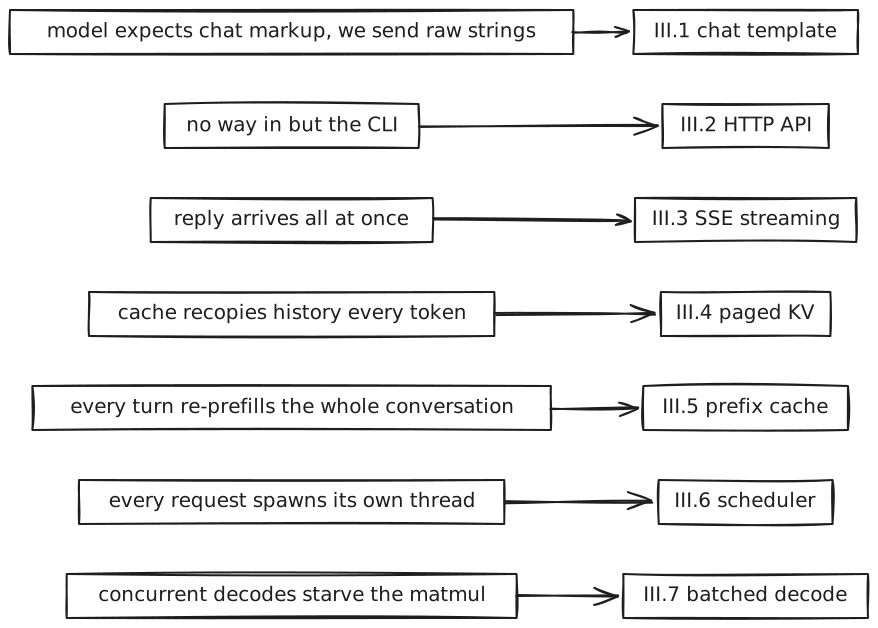
Figure: every chapter in this act exists because something concrete hurts. Left column: the pain. Right column: the chapter that removes it.
What "done" looks like
At the end of Act 3, chat-server --bind 0.0.0.0:8000 model.gguf is an OpenAI-compatible server. Point any OpenAI client at it (curl, the Python SDK, a chat UI) and have a conversation. It admits multiple concurrent conversations, streams each user's tokens back over SSE, allocates KV memory in fixed-size blocks so nothing fragments, reuses cached prompt prefixes, and batches concurrent decode steps into one forward pass.
Start with III.1: Chat pipeline.